AI in finance is moving from assistance to autonomy. Gartner expects 40% of business software to include AI that completes end-to-end tasks by the end of 2026. This industry report gathers what leading academics, practitioners and data scientists building production systems at scale are seeing as that shift happens.

AI in finance is moving from assistance to autonomy. By the end of 2026, Gartner predicts that 40% of business software will include AI capable of completing end-to-end tasks independently- such as fraud detection, loan processing, customer onboarding, or reporting - without human intervention at every step.
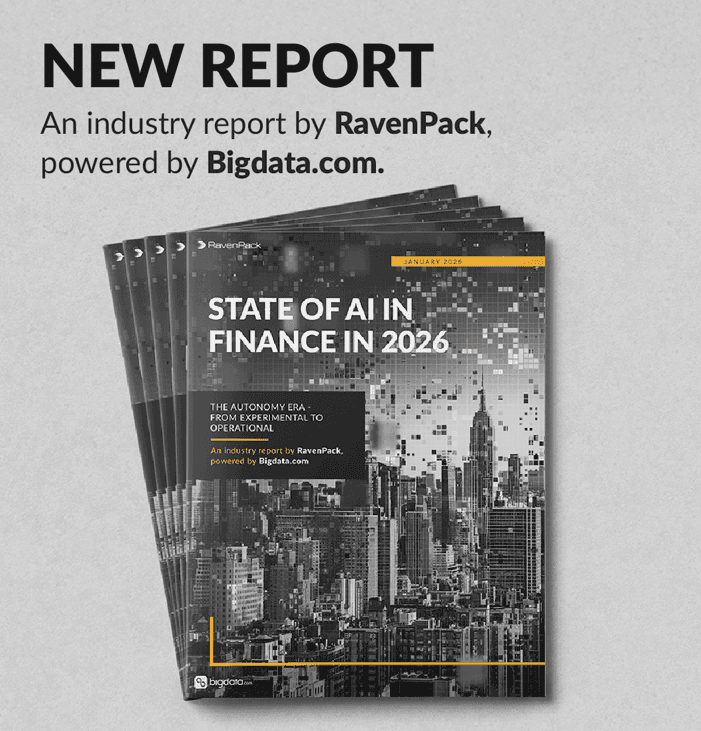
RavenPack’s comprehensive industry report, AI in Finance 2026: The Autonomy Era, powered by Bigdata, brings together insights from leading academics, practitioners, and data scientists building production systems at scale. The report also features data-driven analysis based on Bigdata.com’s trusted financial data packages, generated using advanced AI research methods.
What the report makes clear is that the real winners won’t be those with the “best” AI models, but the organizations building systems that improve over time - powered by high-quality data, compliant processes, and infrastructure designed for production from day one.
What leading experts are seeing
We gathered insights from nine experts at the forefront of AI in finance.Their perspectives reveal crucial patterns:
Professor Mark Salmon, University of Cambridge, has been working with machine learning in finance since 1989. His core message: powerful tools need proper testing. Financial markets differ fundamentally from other fields, and methods that work elsewhere can mislead when money is on the line.
Professor Petter Kolm, NYU's Courant Institute (two-time Quant of the Year), cuts through the hype with a clear point: complex models aren't automatically better. Markets are noisy and constantly changing. What matters is building systems that stay reliable when conditions shift.
Professor Markus Leippold, University of Zurich and Google DeepMind, warns of three emerging traps: AI systems that all think alike can move markets dangerously, we're depending on infrastructure we don't control, and competitive pressure pushes firms to remove human judgment too fast.
Professor Charles-Albert Lehalle, École Polytechnique, points to the real opportunity: smaller, focused models that work with clean data. The future it about AI that fits your specific needs and data.
Peter Hafez, Chief Data Scientist at RavenPack, sees the shift happening now. Standard industry tools are giving way to custom systems. Firms are defining their own ways of understanding risk and finding opportunities, not just using the same categories as everyone else.
Dr. Rajesh T. Krishnamachari describes a new role emerging: the "R-Quant" or Reasoning-Quant. These professionals orchestrate AI systems that handle everything from pulling data to running analysis to supporting decisions—fundamentally different from traditional quant work.
Aakarsh Ramchandani, Chief Product Officer at RavenPack, makes it clear: the bottleneck isn't model intelligence anymore. It's having the systems, memory, security, and processes to let AI run safely in production environments.
Sri Iyer, Guardian Capital's i³ Investments, sees a bigger shift in how work gets done. Middle layers in organizations will flatten. Individual workers will build their own AI tools. The role of leadership is changing to guide this new type of workforce.
Petr Merkuryev, Medusa Investment Partners talks about the wall between fundamental and quant investing coming down. Natural language means domain experts can run complex analysis without coding. The edge is the context and knowledge you feed into the model.
How the Bigdata.com research was conducted
This report itself demonstrates the transition it documents. The research section was generated using Claude Sonnet 4.5 integrated with Bigdata.com's financial datasets through Model Context Protocol (MCP) - the same infrastructure leading financial institutions are now deploying for operational intelligence.
This approach enabled research-grade synthesis across premium news feeds, earnings calls, expert interviews - not as isolated documents but as structured financial intelligence with proper attribution, timestamps, and context.
Premium financial data matters
Generic web search returns whatever ranks highest algorithmically. Financial decision-making requires something more specific: verified sources, proper attribution, temporal context, and the ability to distinguish signal from noise.
For this report, that meant analysis grounded in specific, verifiable sources: earnings calls, SEC, research and expert perspectives. The system could answer questions like "Are institutions seeing measurable ROI?" not with speculation but with specific data points, identifying both where consensus exists and where expert opinions diverge..
Emerging patterns for 2026
Several clear trends emerged from synthesizing dozens of sources across the financial industry:
The hybrid architecture approach: Leading institutions are leveraging foundation models from OpenAI, Anthropic, and Google while building proprietary applications on top of their unique data advantages - not choosing between build and buy, but doing both strategically.
New roles emerging: The "R-Quant" or Reasoning-Quant is becoming a distinct profession: professionals who orchestrate AI systems handling everything from data extraction to analysis to decision support, fundamentally different from traditional quant work.
The infrastructure bottleneck: Intelligence is abundant; production readiness is scarce. The gap between proof-of-concept and operational deployment comes down to persistent memory systems, machine-speed security controls, semantic knowledge graphs, and governance frameworks designed for autonomous execution.
Domain expertise advantage: As natural language interfaces eliminate coding barriers, the competitive edge shifts to the context and knowledge you feed into models, not the models themselves.
What this means for professionals in finance
The capabilities demonstrated in this research process are available today. Financial institutions can integrate the same data sources, reasoning models, and structured analytical approaches. The question is how quickly organizations adapt their research processes to leverage what's now possible.
The complete report goes deep on measurable returns, changing job roles, new regulations, and practical frameworks for deploying AI you can trust. Get the full document for a comprehensive analysis of real deployment patterns across the industry, what's working, what's failing, and how leaders are scaling safely.