
TheBigdata.compluginisnowpartofhowClaudethinksaboutfinance
Institutional financial research in chat, in code and in Cowork
Institutional financial research in chat, in code and in Cowork
By
Bigdata.com team
·

The Bigdata.com plugin now runs wherever Claude runs: Claude.ai chat, Claude Code, Cowork. And with that, something fundamental has shifted: Skills are now front and center - a way to package our expectations of the agent to produce research of the highest quality, powered by the right tools, without all the prompting overhead.
This distinction matters because skills are designed for flexibility. They are natural-language friendly, allowing you to drive research with just a plain question, but also accessible via slash commands (/) for pre-packaged, immediate access to core financial use cases. Whether you prefer a conversational request or a structured shortcut, you are accessing the same powerful research engine.
(A clarification worth making: the MCP is the data connection: the pipe that pulls financials, filings, and sentiment from Bigdata.com into Claude. The plugin is the full package: data connection plus the skills that know what to do with it. You install one thing, and both come with it.)
You ask a question and investment grade research comes back
It really is that simple. Open Claude, type what you’d ask a capable junior analyst:
“Earnings preview for NVIDIA before next week’s print.” “What’s happening with Apple in the last 30 days?””Risk assessment for Tesla.” “Compare the G7 economies right now.”
Claude understands what you’re after, pulls the data, sweeps recent news, filings, and transcripts, and hands back a cited report, structured the way a research note should be, not a wall of AI text. You just asked a question and got a deliverable.
What makes it different from asking a generic AI
The problem with asking a general-purpose AI to “summarize NVIDIA’s quarter” is what you get back: a confident, fluent, wall of text, with minimal confidence on the data backing it up.
Bigdata makes it work differently at every layer:
The data is trustworthy: it pulls structured financials, analyst estimates, sentiment data, and an events calendar directly from Bigdata.com, then sweeps SEC filings, earnings transcripts, and news with inline citations. When a PM asks where a claim came from, you can point to the source.
The structure is professional: every output is forced through a research framework: explicit variant perception versus consensus, scenario analysis with probability weights, earnings quality screens, sector-specific KPIs. A closing PM-style line ( net assessment, key risk, next catalyst) anchors every deliverable.
The methodology is sector-aware: the skill quietly applies Graham-Dodd discipline, Porter Five Forces, DCF and multiples routed by company type, and dedicated playbooks for tech-SaaS, financials, healthcare, energy, industrials, consumer-retail, and REITs.
22 workflows, one conversation
Whether you need a quick take for a morning meeting or a full investment memo, the skill covers it. Single-name work: company briefs, earnings previews, earnings digests and reactions, risk assessments, valuation snapshots, peer comparables, moat and governance reviews, scenario analysis, catalyst monitoring, variant perception, and earnings quality screens.
Macro work: sector analysis, country analysis, G7 comparisons, regional comparisons, thematic research, cross-sector rotation, and sector playbooks.
All of it is reachable the same way: just ask. Or, if you prefer to browse, open the slash-command picker (/) and scroll through the catalog. Every workflow is listed with a short description.
What this looks like in practice
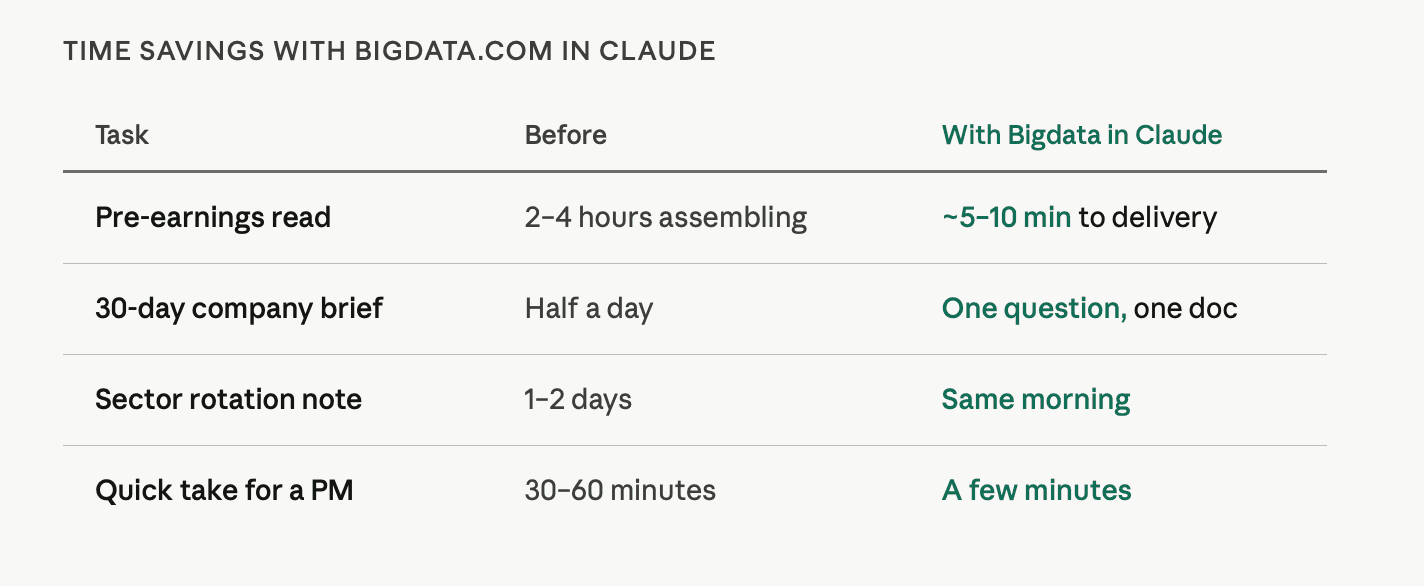
The methodology is sharpest for fundamental and macro research, but the skill’s reach is wide.
Buy-side equity analysts and PMs get standardized, cited prep that frees time for the part that can’t be automated: forming the actual view.
Macro strategists and asset allocators get country tearsheets, G7 comparisons, and sector rotation notes from a single conversation, without spinning up a separate macro stack.
Sell-side analysts, IR teams, and corp dev get the same EPIC / FaVeS / scenario discipline applied to competitive intelligence, peer comps, and publishable notes.
Wealth managers, RIAs, and family offices get decision-ready research with cited sources and a standard disclaimer footer built in — the compliance-friendly version by default.
Sophisticated retail investors get institutional-grade structure on any name they care about, without a Bloomberg subscription.
Available wherever you use Claude
The plugin runs in Claude.ai chat, Claude Code, and Cowork with the same skills and data engine and with no special setup required. If you already have Claude, you’re one connection away.
Connect the Bigdata.com plugin
Requires an active Bigdata.com subscription. If you don’t have an account yet, there’s a 14 day free trial. Find out more at: https://bigdata.com/claude
The Bigdata.com plugin now runs wherever Claude runs: Claude.ai chat, Claude Code, Cowork. And with that, something fundamental has shifted: Skills are now front and center - a way to package our expectations of the agent to produce research of the highest quality, powered by the right tools, without all the prompting overhead.
This distinction matters because skills are designed for flexibility. They are natural-language friendly, allowing you to drive research with just a plain question, but also accessible via slash commands (/) for pre-packaged, immediate access to core financial use cases. Whether you prefer a conversational request or a structured shortcut, you are accessing the same powerful research engine.
(A clarification worth making: the MCP is the data connection: the pipe that pulls financials, filings, and sentiment from Bigdata.com into Claude. The plugin is the full package: data connection plus the skills that know what to do with it. You install one thing, and both come with it.)
You ask a question and investment grade research comes back
It really is that simple. Open Claude, type what you’d ask a capable junior analyst:
“Earnings preview for NVIDIA before next week’s print.” “What’s happening with Apple in the last 30 days?””Risk assessment for Tesla.” “Compare the G7 economies right now.”
Claude understands what you’re after, pulls the data, sweeps recent news, filings, and transcripts, and hands back a cited report, structured the way a research note should be, not a wall of AI text. You just asked a question and got a deliverable.
What makes it different from asking a generic AI
The problem with asking a general-purpose AI to “summarize NVIDIA’s quarter” is what you get back: a confident, fluent, wall of text, with minimal confidence on the data backing it up.
Bigdata makes it work differently at every layer:
The data is trustworthy: it pulls structured financials, analyst estimates, sentiment data, and an events calendar directly from Bigdata.com, then sweeps SEC filings, earnings transcripts, and news with inline citations. When a PM asks where a claim came from, you can point to the source.
The structure is professional: every output is forced through a research framework: explicit variant perception versus consensus, scenario analysis with probability weights, earnings quality screens, sector-specific KPIs. A closing PM-style line ( net assessment, key risk, next catalyst) anchors every deliverable.
The methodology is sector-aware: the skill quietly applies Graham-Dodd discipline, Porter Five Forces, DCF and multiples routed by company type, and dedicated playbooks for tech-SaaS, financials, healthcare, energy, industrials, consumer-retail, and REITs.
22 workflows, one conversation
Whether you need a quick take for a morning meeting or a full investment memo, the skill covers it. Single-name work: company briefs, earnings previews, earnings digests and reactions, risk assessments, valuation snapshots, peer comparables, moat and governance reviews, scenario analysis, catalyst monitoring, variant perception, and earnings quality screens.
Macro work: sector analysis, country analysis, G7 comparisons, regional comparisons, thematic research, cross-sector rotation, and sector playbooks.
All of it is reachable the same way: just ask. Or, if you prefer to browse, open the slash-command picker (/) and scroll through the catalog. Every workflow is listed with a short description.
What this looks like in practice
The methodology is sharpest for fundamental and macro research, but the skill’s reach is wide.
Buy-side equity analysts and PMs get standardized, cited prep that frees time for the part that can’t be automated: forming the actual view.
Macro strategists and asset allocators get country tearsheets, G7 comparisons, and sector rotation notes from a single conversation, without spinning up a separate macro stack.
Sell-side analysts, IR teams, and corp dev get the same EPIC / FaVeS / scenario discipline applied to competitive intelligence, peer comps, and publishable notes.
Wealth managers, RIAs, and family offices get decision-ready research with cited sources and a standard disclaimer footer built in — the compliance-friendly version by default.
Sophisticated retail investors get institutional-grade structure on any name they care about, without a Bloomberg subscription.
Available wherever you use Claude
The plugin runs in Claude.ai chat, Claude Code, and Cowork with the same skills and data engine and with no special setup required. If you already have Claude, you’re one connection away.
Connect the Bigdata.com plugin
Requires an active Bigdata.com subscription. If you don’t have an account yet, there’s a 14 day free trial. Find out more at: https://bigdata.com/claude



Developers
© 2026 Bigdata.com by RavenPack. All rights reserved.
Developers
© 2026 Bigdata.com by RavenPack. All rights reserved.