
BringingBigdata.comportfoliomonitoringtoClaude,ChatGPTandGrok
Turn a portfolio screenshot into a Bigdata.com watchlist and get a daily, cited brief in Claude, ChatGPT or Grok. See two real briefs from October 2026.
Turn a portfolio screenshot into a Bigdata.com watchlist and get a daily, cited brief in Claude, ChatGPT or Grok. See two real briefs from October 2026.
By
Daniel Benitez, Head of product, Bigdata.com
·

Most investors don't follow a single company. They follow a list, whether that's a portfolio, a watchlist, a sector or an index, and every day they want to know if anything happened to the companies on it. A news feed answers that with hundreds of headlines. What people actually want from portfolio monitoring is the handful of stories that matter, an explanation for anything that moved sharply, a look at what's coming up, and a source they can check for every line.
The story behind this
Since we launched the Bigdata.com Plugin for assistants like Claude, ChatGPT and Grok, single-name analysis is where we've seen people get the most value. They use it to pull apart an earnings call, put together a company brief, or test a thesis against filings and the news, and they get a grounded answer with sources attached.
Once that works for one company, people want it for twenty, then for a whole portfolio, then for every constituent of an index or a theme. Our users kept telling us the same thing, which is that many of the questions that matter most to them are about lists.
That's familiar ground for us. Working across entire universes of companies is what RavenPack has done for 20+ years. Every company is mapped to an entity in our knowledge graph, and news, filings, transcripts and market data are tracked across thousands of names at once. We took those learnings, along with what users told us, and packaged them so the assistant you already use can work the same way through our connector. It can build a list and keep it, pull data across every name in one go, and search the whole list at once.
What it looks like, end to end
So we started with the simplest input there is, a screenshot of a brokerage account. Everything below is real output, generated on October 6 and 7, 2026, from a sample portfolio of 20 global large caps. Example done in Claude but all assistants support the same capabilities with the Bigdata.com Plugin.
1. Turn any list into a watchlist
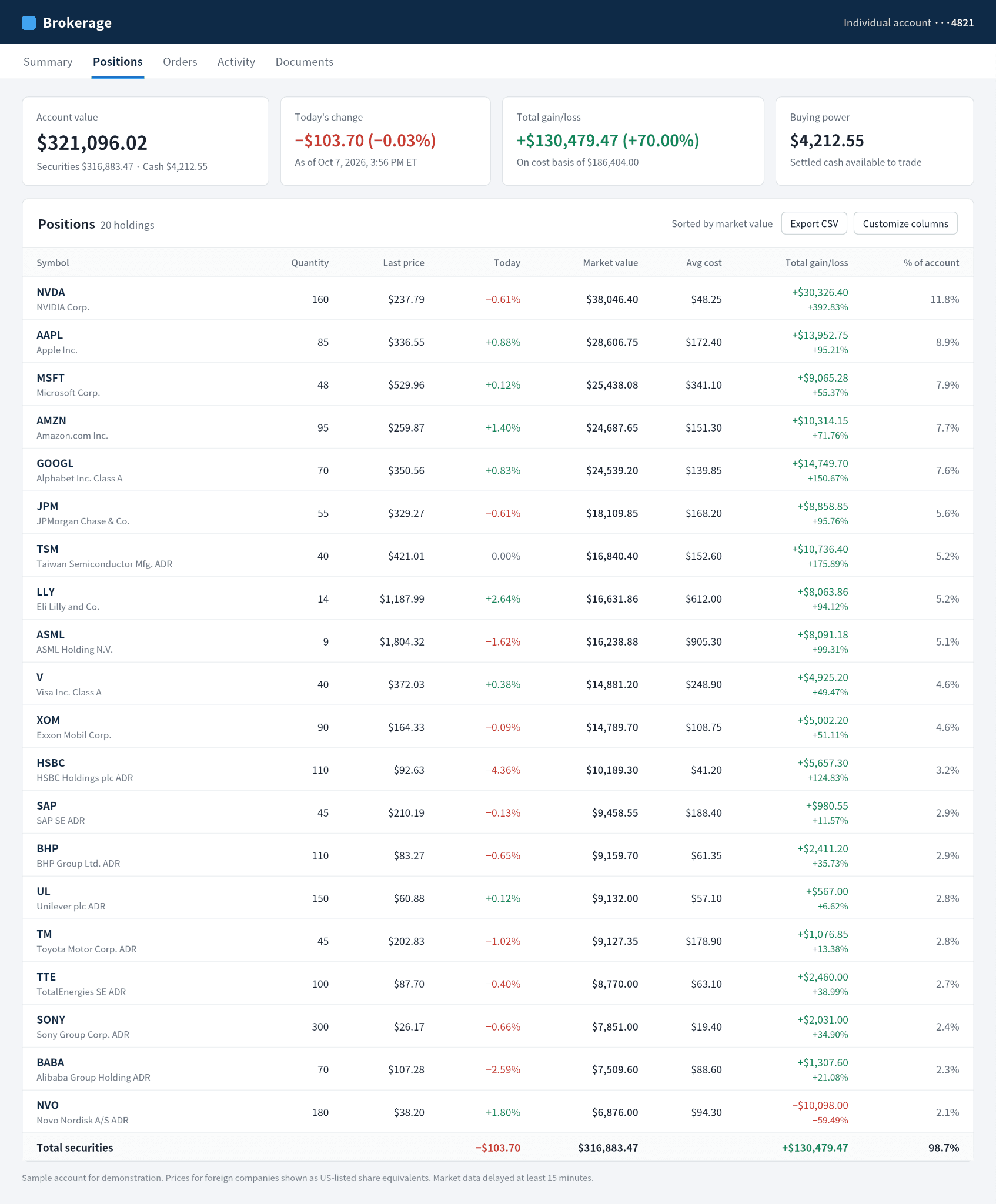
The assistant reads the tickers off the screenshot, and our knowledge graph matches each one to a company, wherever it trades. TSM on the New York Stock Exchange is recognized as TSMC, the same company as its Taipei listing. SONY becomes Sony Group and BHP becomes BHP Group in Sydney. All 20 matched on the first pass.
The assistant then saves the list as a watchlist in your Bigdata.com account. Bigdata stores only the companies, not your share counts or dollar values. Whenever your holdings change, your assistant can update the watchlist to match. And once it exists, the watchlist becomes an asset in its own right. Every capability in the plugin can work from it in the same way, whether that's pulling a grid of market data, searching across every name, checking the earnings calendar or writing tomorrow's brief.
2. See the whole list at a glance
A single request returns a grid covering every company on the list, with price, the day's move, last earnings against forecast, the range of analyst targets, news sentiment and market value. Here's part of it from October 7.
Company | Price | Today | Last earnings vs forecast | Analyst target (range) | News sentiment |
|---|---|---|---|---|---|
NVIDIA | $237.36 | −0.79% | +6.2% | $339 ($210 to $515) | 0.24 |
Eli Lilly | $1,188.72 | +2.70% | +30.9% | $1,344 ($940 to $1,500) | 0.15 |
ASML | $1,804.96 | −1.59% | +8.8% | $2,331 ($2,100 to $2,623) | 0.12 |
Visa | $372.10 | +0.39% | +2.8% | $422 ($350 to $466) | 0.39 |
Novo Nordisk | $38.26 | +1.95% | +17.1% | $44.67 ($40 to $47) | −0.12 |
HSBC | 1,408p | −4.36% | +1.4% | n/a | −0.24 |
HSBC is quoted in pence because the grid reports each company on its home market, which for HSBC is London.
A grid like this is good at showing which names deserve a closer look, but it can't tell you why HSBC was down 4% that day. For that you need the content.
3. Search every name at once
Searching a list used to mean running one search per company. Here a single request covers every company on the list across news, filings, earnings call transcripts and research. Each company gets its own share of the results, so the heavily covered mega caps can't crowd out the quieter holdings, and it works the same way whether the list has 20 names or several hundred.
Building the daily brief taught us a couple of things. The first is that raw results need filtering. On October 7 the search returned something for 8 of the 20 names, and none of it was worth a reader's time. There were routine structured-product filings, an ad from a law firm, and a column that mentioned Amazon in passing. So the brief only keeps an item if the company is actually involved, if it's new since the last brief, and if it matters.
The second is that price moves are a good guide to where to dig. HSBC fell 4.4% that day, and the broad search came back with nothing on it. Now any holding that moves more than 2% gets its own follow-up search, and the brief either explains the move or says there was no company-specific news.
4. Know what's coming
The same list also feeds a calendar of upcoming events. For this portfolio, third-quarter earnings season starts next week, with JPMorgan reporting on October 13, ASML on the 14th, TSMC on the 15th, Exxon on the 16th and SAP on the 21st.
5. Make it a daily habit that remembers
Running all of this once gives you a useful snapshot. Running it every weekday after the close is what turns it into a habit. Each brief is saved back to Bigdata as a “memory”, and the next one reads it before writing anything, which is how it avoids telling you the same thing twice. A story only comes back when something about it changes, such as a report being confirmed or a date moving.
Two evenings of briefs
These are the two briefs produced for the sample portfolio, with every fact linked to its source on Bigdata.com.
Your portfolio, Tuesday, October 6, after the close 20 names tracked, 2 with news, 18 quiet
Microsoft signed a long-term Xbox publisher license with Take-Two that folds their earlier Xbox deals into one agreement covering current and future titles. Simply Wall St
SAP is moving its AI agents into back-office work such as financial close and trade compliance. It also launched SAP Pay, which pays approved invoices from inside SAP Cloud ERP and can settle cross-border payments in stablecoins. The service is live in the US and UK. The New Stack
Coming up: TSMC reports third-quarter results on October 15. Ahead of the report, Yuanta raised its target to NT$3,500 from NT$3,300 and said it expects price increases of 5 to 10% on advanced chips in 2027. Yuanta Also reporting are JPMorgan (October 13), ASML (October 14), Exxon (October 16) and SAP (October 21).
We generated this brief after the fact, so it has no price grid. The grid always reports the latest session.
Your portfolio, Wednesday, October 7, after the close 20 names tracked, 4 worth reading, 16 quiet
Top line: HSBC led the portfolio lower after a report on AI-driven job cuts in its UK wealth business, on a day when European banks sold off broadly.
Moved more than 2%: HSBC (−4.4%), Eli Lilly (+2.7%) and Alibaba (−2.6%)
HSBC (−4.4%). The Financial Times reported that HSBC is weighing sweeping job cuts in its UK wealth management arm as it moves toward AI-assisted advice. MT Newswires Later coverage put the reported scope at around 70% of adviser roles. Yahoo Finance The bank said a consultation is under way. Part of the drop wasn't specific to HSBC, since other UK banks fell by roughly 3 to 4.5% as the bond sell-off resumed. Alliance News
BHP agreed to sell its Kambalda nickel concentrator, together with related tenements and mineral rights, to Gold Fields. It's a small deal for a company of BHP's size. MT Newswires
Eli Lilly (+2.7%). There was no company news. The move came as Morgan Stanley raised its target to $1,430 from $1,419, keeping an Overweight rating, while updating its biopharma models ahead of the third quarter. The Fly
Alibaba (−2.6%). There was no company-specific news. Hong Kong tech stocks fell on high US Treasury yields and on caution before mainland markets reopen on October 8 after the Golden Week holiday. InvestingCube
Coming up: JPMorgan (October 13), ASML (October 14), TSMC (October 15), Exxon (October 16) and SAP (October 21).
Wednesday's search also turned up another preview of TSMC's October 15 results, this time a market column from Taiwan's Chinatimes. Tuesday's brief had already covered the date, so Wednesday kept it under Coming up rather than repeating it. The column was published in Chinese, and it was still matched to the same company as the NYSE ticker in the screenshot.
Why this works
All of these capabilities rely on the same thing, which is that every company has one identity in our knowledge graph.
That's why a US-listed share, its home listing, a Taipei market column written in Chinese and an English newswire story all end up attached to the same company, and why a screenshot of US tickers can drive a search across global content.
It also means the structured data and the unstructured content line up. Prices, forecasts, analyst targets, sentiment and the earnings calendar sit on the same company as the news, filings, transcripts and research, so the grid can flag a name and the search can explain what happened to it.
And because the watchlist is saved, you only build it once. The grid, the search, the calendar and the daily brief all work from that same list, and when your holdings change, the assistant updates it instead of creating another one.
Try it
Add the Bigdata.com Plugin to Claude, ChatGPT or Grok, and it takes two prompts.
To set it up, use this once: "Here's a screenshot of my portfolio. Create a Bigdata watchlist from the tickers, without quantities or values, and show me how the list looks today."
Claude, ChatGPT and Grok all support scheduled tasks/automations, so set this second one to run every weekday after the close: "Brief me on my portfolio watchlist since my last brief. Explain any move over 2%, skip names with nothing new, add earnings dates for the next two weeks, cite every fact, and save the brief so tomorrow's can build on it."
What's next
We're taking the same building blocks further, so that much larger jobs can run through the same Plugin, from hundreds of names to thousands, with no extra complexity on your side. It will be faster and more efficient, and more of our data will be within reach of a single request, while the prompts stay just as simple. We'll share more soon.
Sample portfolio for illustration only; not investment advice. Market data and content via Bigdata.com, October 6 and 7, 2026.
Most investors don't follow a single company. They follow a list, whether that's a portfolio, a watchlist, a sector or an index, and every day they want to know if anything happened to the companies on it. A news feed answers that with hundreds of headlines. What people actually want from portfolio monitoring is the handful of stories that matter, an explanation for anything that moved sharply, a look at what's coming up, and a source they can check for every line.
The story behind this
Since we launched the Bigdata.com Plugin for assistants like Claude, ChatGPT and Grok, single-name analysis is where we've seen people get the most value. They use it to pull apart an earnings call, put together a company brief, or test a thesis against filings and the news, and they get a grounded answer with sources attached.
Once that works for one company, people want it for twenty, then for a whole portfolio, then for every constituent of an index or a theme. Our users kept telling us the same thing, which is that many of the questions that matter most to them are about lists.
That's familiar ground for us. Working across entire universes of companies is what RavenPack has done for 20+ years. Every company is mapped to an entity in our knowledge graph, and news, filings, transcripts and market data are tracked across thousands of names at once. We took those learnings, along with what users told us, and packaged them so the assistant you already use can work the same way through our connector. It can build a list and keep it, pull data across every name in one go, and search the whole list at once.
What it looks like, end to end
So we started with the simplest input there is, a screenshot of a brokerage account. Everything below is real output, generated on October 6 and 7, 2026, from a sample portfolio of 20 global large caps. Example done in Claude but all assistants support the same capabilities with the Bigdata.com Plugin.
1. Turn any list into a watchlist
The assistant reads the tickers off the screenshot, and our knowledge graph matches each one to a company, wherever it trades. TSM on the New York Stock Exchange is recognized as TSMC, the same company as its Taipei listing. SONY becomes Sony Group and BHP becomes BHP Group in Sydney. All 20 matched on the first pass.
The assistant then saves the list as a watchlist in your Bigdata.com account. Bigdata stores only the companies, not your share counts or dollar values. Whenever your holdings change, your assistant can update the watchlist to match. And once it exists, the watchlist becomes an asset in its own right. Every capability in the plugin can work from it in the same way, whether that's pulling a grid of market data, searching across every name, checking the earnings calendar or writing tomorrow's brief.
2. See the whole list at a glance
A single request returns a grid covering every company on the list, with price, the day's move, last earnings against forecast, the range of analyst targets, news sentiment and market value. Here's part of it from October 7.
Company | Price | Today | Last earnings vs forecast | Analyst target (range) | News sentiment |
|---|---|---|---|---|---|
NVIDIA | $237.36 | −0.79% | +6.2% | $339 ($210 to $515) | 0.24 |
Eli Lilly | $1,188.72 | +2.70% | +30.9% | $1,344 ($940 to $1,500) | 0.15 |
ASML | $1,804.96 | −1.59% | +8.8% | $2,331 ($2,100 to $2,623) | 0.12 |
Visa | $372.10 | +0.39% | +2.8% | $422 ($350 to $466) | 0.39 |
Novo Nordisk | $38.26 | +1.95% | +17.1% | $44.67 ($40 to $47) | −0.12 |
HSBC | 1,408p | −4.36% | +1.4% | n/a | −0.24 |
HSBC is quoted in pence because the grid reports each company on its home market, which for HSBC is London.
A grid like this is good at showing which names deserve a closer look, but it can't tell you why HSBC was down 4% that day. For that you need the content.
3. Search every name at once
Searching a list used to mean running one search per company. Here a single request covers every company on the list across news, filings, earnings call transcripts and research. Each company gets its own share of the results, so the heavily covered mega caps can't crowd out the quieter holdings, and it works the same way whether the list has 20 names or several hundred.
Building the daily brief taught us a couple of things. The first is that raw results need filtering. On October 7 the search returned something for 8 of the 20 names, and none of it was worth a reader's time. There were routine structured-product filings, an ad from a law firm, and a column that mentioned Amazon in passing. So the brief only keeps an item if the company is actually involved, if it's new since the last brief, and if it matters.
The second is that price moves are a good guide to where to dig. HSBC fell 4.4% that day, and the broad search came back with nothing on it. Now any holding that moves more than 2% gets its own follow-up search, and the brief either explains the move or says there was no company-specific news.
4. Know what's coming
The same list also feeds a calendar of upcoming events. For this portfolio, third-quarter earnings season starts next week, with JPMorgan reporting on October 13, ASML on the 14th, TSMC on the 15th, Exxon on the 16th and SAP on the 21st.
5. Make it a daily habit that remembers
Running all of this once gives you a useful snapshot. Running it every weekday after the close is what turns it into a habit. Each brief is saved back to Bigdata as a “memory”, and the next one reads it before writing anything, which is how it avoids telling you the same thing twice. A story only comes back when something about it changes, such as a report being confirmed or a date moving.
Two evenings of briefs
These are the two briefs produced for the sample portfolio, with every fact linked to its source on Bigdata.com.
Your portfolio, Tuesday, October 6, after the close 20 names tracked, 2 with news, 18 quiet
Microsoft signed a long-term Xbox publisher license with Take-Two that folds their earlier Xbox deals into one agreement covering current and future titles. Simply Wall St
SAP is moving its AI agents into back-office work such as financial close and trade compliance. It also launched SAP Pay, which pays approved invoices from inside SAP Cloud ERP and can settle cross-border payments in stablecoins. The service is live in the US and UK. The New Stack
Coming up: TSMC reports third-quarter results on October 15. Ahead of the report, Yuanta raised its target to NT$3,500 from NT$3,300 and said it expects price increases of 5 to 10% on advanced chips in 2027. Yuanta Also reporting are JPMorgan (October 13), ASML (October 14), Exxon (October 16) and SAP (October 21).
We generated this brief after the fact, so it has no price grid. The grid always reports the latest session.
Your portfolio, Wednesday, October 7, after the close 20 names tracked, 4 worth reading, 16 quiet
Top line: HSBC led the portfolio lower after a report on AI-driven job cuts in its UK wealth business, on a day when European banks sold off broadly.
Moved more than 2%: HSBC (−4.4%), Eli Lilly (+2.7%) and Alibaba (−2.6%)
HSBC (−4.4%). The Financial Times reported that HSBC is weighing sweeping job cuts in its UK wealth management arm as it moves toward AI-assisted advice. MT Newswires Later coverage put the reported scope at around 70% of adviser roles. Yahoo Finance The bank said a consultation is under way. Part of the drop wasn't specific to HSBC, since other UK banks fell by roughly 3 to 4.5% as the bond sell-off resumed. Alliance News
BHP agreed to sell its Kambalda nickel concentrator, together with related tenements and mineral rights, to Gold Fields. It's a small deal for a company of BHP's size. MT Newswires
Eli Lilly (+2.7%). There was no company news. The move came as Morgan Stanley raised its target to $1,430 from $1,419, keeping an Overweight rating, while updating its biopharma models ahead of the third quarter. The Fly
Alibaba (−2.6%). There was no company-specific news. Hong Kong tech stocks fell on high US Treasury yields and on caution before mainland markets reopen on October 8 after the Golden Week holiday. InvestingCube
Coming up: JPMorgan (October 13), ASML (October 14), TSMC (October 15), Exxon (October 16) and SAP (October 21).
Wednesday's search also turned up another preview of TSMC's October 15 results, this time a market column from Taiwan's Chinatimes. Tuesday's brief had already covered the date, so Wednesday kept it under Coming up rather than repeating it. The column was published in Chinese, and it was still matched to the same company as the NYSE ticker in the screenshot.
Why this works
All of these capabilities rely on the same thing, which is that every company has one identity in our knowledge graph.
That's why a US-listed share, its home listing, a Taipei market column written in Chinese and an English newswire story all end up attached to the same company, and why a screenshot of US tickers can drive a search across global content.
It also means the structured data and the unstructured content line up. Prices, forecasts, analyst targets, sentiment and the earnings calendar sit on the same company as the news, filings, transcripts and research, so the grid can flag a name and the search can explain what happened to it.
And because the watchlist is saved, you only build it once. The grid, the search, the calendar and the daily brief all work from that same list, and when your holdings change, the assistant updates it instead of creating another one.
Try it
Add the Bigdata.com Plugin to Claude, ChatGPT or Grok, and it takes two prompts.
To set it up, use this once: "Here's a screenshot of my portfolio. Create a Bigdata watchlist from the tickers, without quantities or values, and show me how the list looks today."
Claude, ChatGPT and Grok all support scheduled tasks/automations, so set this second one to run every weekday after the close: "Brief me on my portfolio watchlist since my last brief. Explain any move over 2%, skip names with nothing new, add earnings dates for the next two weeks, cite every fact, and save the brief so tomorrow's can build on it."
What's next
We're taking the same building blocks further, so that much larger jobs can run through the same Plugin, from hundreds of names to thousands, with no extra complexity on your side. It will be faster and more efficient, and more of our data will be within reach of a single request, while the prompts stay just as simple. We'll share more soon.
Sample portfolio for illustration only; not investment advice. Market data and content via Bigdata.com, October 6 and 7, 2026.



Developers
© 2026 Bigdata.com by RavenPack. All rights reserved.
Developers
© 2026 Bigdata.com by RavenPack. All rights reserved.